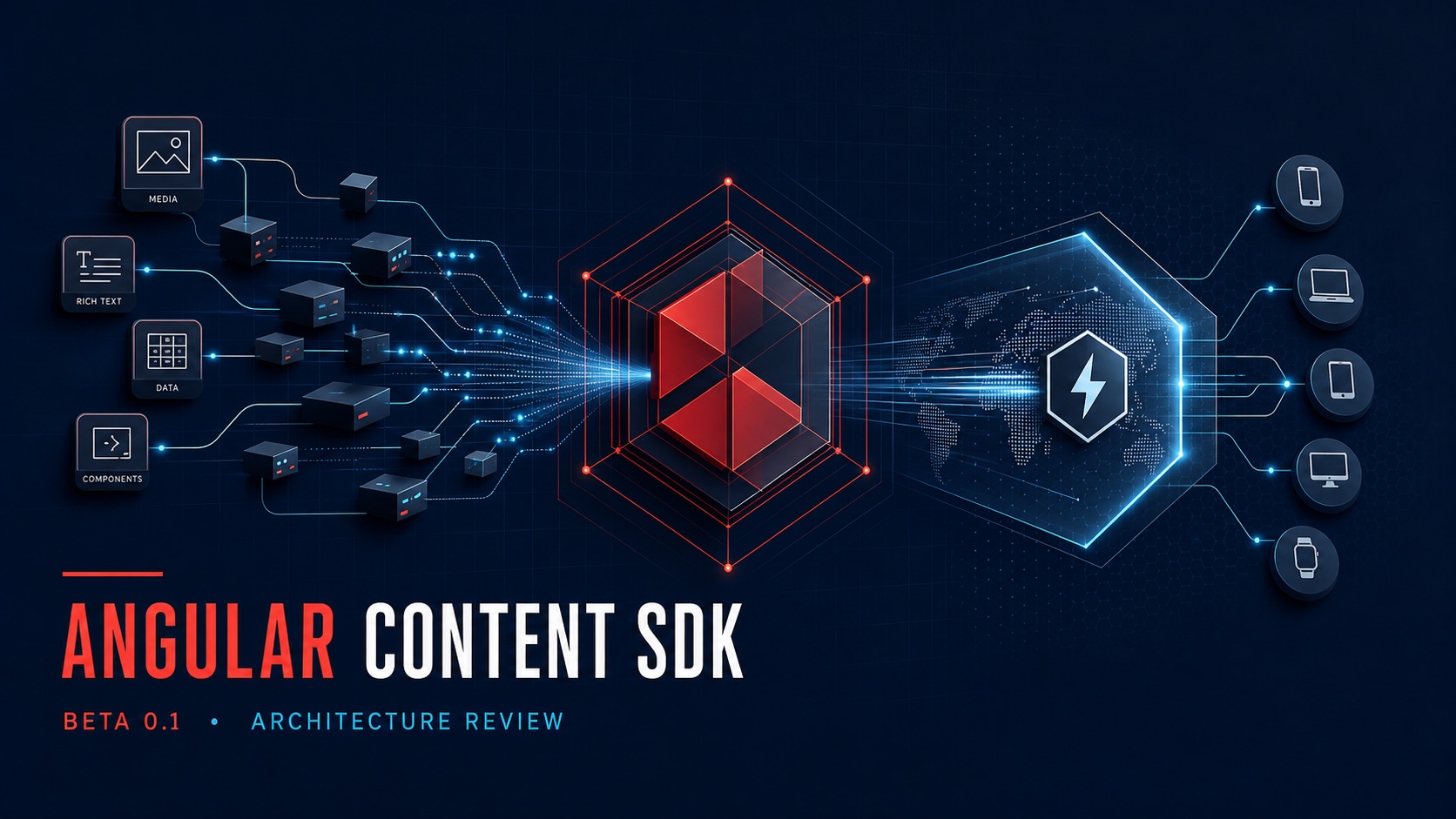
Sitecore’s Angular beta matters because it changes the choice facing enterprise teams. Angular is no longer merely a framework that can consume Experience Edge; it now has an Angular-native Content SDK path into SitecoreAI’s visual editing, personalization, analytics, multilingual, and multisite capabilities.
That is meaningful progress, but beta 0.1 is a foundation—not an automatic production recommendation. I reviewed the July 16 announcement, the new 0.x documentation, package source and tests, release notes, the open pull-request queue, and recent community discussions. My conclusion is positive but conditional: the architecture is coherent and genuinely Angular-shaped, while operational maturity, security hardening, framework parity, and upgrade tolerance still need to be proven in each organization.
What actually shipped
The release is built around current Angular conventions: standalone components, signals, dependency injection, route resolvers, and server-side rendering. A loader framework retrieves layout and dictionary data on the server and passes resolved state into the application. Sitecore provides a unified configuration entry point and scaffolding through create-content-sdk-app.
The package changelog adds implementation detail: basic rendering and a sample app, internationalization, multisite, editing and preview, personalization plus analytics page-view events, stale-while-revalidate caching, sitemap and robots endpoints, and component-level Angular guards. The package currently declares Angular 21 peer dependencies. Platform-server and SSR are optional peers, which suggests the library boundary supports more than one Angular hosting shape even though Sitecore’s strongest architectural story is SSR.
The public documentation also promises Pages visual editing, A/B/n component testing without custom integration code, GraphQL utilities for content/layout/site/dictionary queries, and out-of-box analytics, tracking, and personalization. One important limitation is explicit: sites do not support different default languages by default, so multilingual multisite teams must design locale routing deliberately.
Code deep dive: how a request really moves
The package is not a thin collection of field components. It installs a parallel server/browser data path around Angular Router. A route uses loaderResolver(loaderId, cacheOptions). During SSR, the resolver injects the incoming request and a ServerLoaderRunner; during client navigation it calls a POST endpoint, /_data. The result is placed into Angular TransferState under loader:{id}:{url}, consumed once in the browser, and then removed.
SSR: Router resolver → ServerLoaderRunner → loader(ctx) → TransferState → HTML
CSR: ActivationStart → parallel prefetch → POST /_data → staged response → resolver
Cache: hit → return | stale → return + background refresh | miss → run + store
This is a thoughtful answer to a real Angular problem. Angular executes resolvers in route order, which can serialize independent data calls. ClientPreLoaderDataService listens for the leaf ActivationStart, walks parent routes, discovers resolver functions carrying the private LOADER_ID symbol, and starts their requests in parallel. ClientLoaderDataService also deduplicates concurrent calls using a pending promise map. The upside is lower navigation waterfalls. The cost is a custom data protocol that must now be secured, observed, versioned, and kept consistent with route configuration.
Loader context: flexible, but two sources of truth
Server-derived values—hostname, cookies, headers, Sitecore preview data, site and personalization parameters—are extracted from the actual request. That prevents a browser from simply posting a fake scParams object. However, the browser does post loaderId, URL, route parameters, query values, and per-route cache options. The middleware spreads that payload into the runner with only a required loaderId check. A registered loader ID limits arbitrary code execution, but application loaders must still treat URL, route params and query as hostile input.
/_data contract currently has minimal runtime schema validation. A client can submit a registered loader ID with invented URL/route/query values and cache overrides. Put body-size limits, rate limits, strict schemas and authorization around any loader that returns non-public domain data. Do not assume Angular Router is the only caller.Cache mechanics: strong SWR design, incomplete variation story
The server runner implements cache-aside with three states. A stale entry is returned immediately while a process-wide Set coalesces refreshes for the same key. Redirects are not cached. Editing requests disable the loader cache when the internal editing header is present. Cache writes fail open: the request still succeeds and logs a warning. These are good availability choices.
Keys are deterministic: page entries use sc:loader:page:{site}:{locale}:{variantId}:{path}; dictionaries use one key per site and locale. Stored entries receive self, site, locale and content-item tags, allowing an Experience Edge webhook to mark matching entries stale rather than delete them.
dimensionsFromContext collects both the page variantId and componentVariantIds, but buildPageCacheKey serializes only the page variant. If component-level A/B variants change while the page-level variant remains the same, different component experiences appear capable of sharing one cached page payload. I would disable page caching for component-level experiments until Sitecore confirms the intended variation strategy or the key includes a stable component-variant fingerprint.unstorage driver can share entries, but tag-index updates are read-modify-write operations without an obvious distributed lock or transaction. High-volume publishing needs concurrency and tag-index integrity tests against the chosen driver.Dynamic component rendering
ScPlaceholderComponent is signal-driven. Each update clears its ViewContainerRef, resolves renderings from the layout, runs a synchronous guard resolver and data resolver, then creates mapped Angular components dynamically and sets fields, params and rendering inputs. Pass-through inputs can decorate every child. In editing mode it emits Sitecore metadata chrome before and after placeholders and renderings—even for declared-but-empty placeholders, which is essential for author insertion.
This model is extensible and testable, but guard and data resolvers are synchronous by design. Async domain data belongs in the page loader. That is a sensible performance constraint, though it makes the page loader an attractive place to accumulate too many integrations. Also, FEaaS/BYOC renderings are explicitly not handled by component resolution in this beta; they fall through to the missing-component path.
Personalization is server middleware, not a template trick
The personalization middleware resolves available variants from Experience Edge, groups page and component executions, and calls Sitecore Personalize in parallel. It initializes server analytics and personalization adapters with cookies, supports UTM, referrer and optional geo inputs, validates returned variant IDs against the offered set, then places the selected IDs into request state and an internal header so Angular SSR retains them.
It deliberately skips editing/preview and static/API paths. It also detects browser prefetch requests and avoids executing experiments, returning Cache-Control: no-store so speculative navigation does not contaminate A/B metrics. That is a strong, non-obvious implementation detail. Conversely, the catch block logs and continues: a CDP failure degrades to the default experience, which improves resilience but requires monitoring because the visitor sees no error and experiment allocation can silently fall.
Analytics is lazy and deliberately non-blocking
The browser analytics facade initializes only on the first event, memoizes concurrent initialization, and becomes a no-op during Angular development or when clientContextId is absent. Identical page views are deduplicated within one second to avoid hydration replay. Dispatch failures are swallowed at debug level so analytics cannot break navigation. This is appropriate for experience delivery, but production observability must detect sustained event loss outside the browser console.
Pros and cons after reading the implementation
| Dimension | Upside | Cost or uncertainty |
|---|---|---|
| Angular integration | Standalone components, signals, DI tokens, Router resolvers, TransferState and platform-specific providers are used directly. | Angular 21 peers create a hard modernization boundary; the package is not a low-friction addition to Angular 15–20 estates. |
| Navigation | Parent/child loader prefetch and pending-promise dedup reduce sequential resolver waterfalls. | The custom /_data endpoint expands the public attack surface and needs validation, throttling and tracing. |
| Caching | Real SWR states, pluggable unstorage, content tags, webhook invalidation, edit-mode bypass and redirect exclusion. | Component experiment IDs are not visibly serialized in page keys; refresh locks are process-local; tag indexes may race on shared storage. |
| Components | Dynamic mapping, missing/hidden fallbacks, SXA parameters, edit chrome, synchronous guards and pass-through inputs. | Each placeholder update clears and recreates child views; async enrichment is pushed into loaders; FEaaS/BYOC resolution is intentionally absent. |
| Personalization | Server-side execution, prefetch protection, parallel variant decisions and graceful default-experience fallback. | Cookie/consent policy and cache variation are application responsibilities; swallowed failures can hide lost personalization without external telemetry. |
| Analytics | Lazy initialization, hydration deduplication, server no-op implementation and failure isolation. | Disabled/misconfigured analytics fails quietly; a one-second fingerprint window is useful but not a substitute for route-event governance. |
| Configuration | A single typed configuration resolves locales, redirects, cache defaults and Sitecore connection details. | clientEnv and process.env are merged into one resolved object; teams must prove server secrets cannot enter browser-referenced configuration. |
Security review: three concrete code paths
This is a source review, not a penetration test, and I am not asserting a published vulnerability. However, three implementation details deserve immediate verification before an internet-facing production deployment.
ScRichTextDirective takes the CMS value, calls bypassSecurityTrustHtml(raw), then passes that trusted value to sanitize(SecurityContext.HTML, trusted) before assigning innerHTML. Angular’s trust-bypass API marks a value safe; passing the resulting SafeHtml back through the sanitizer unwraps the trusted value rather than applying normal HTML sanitization. Unless Sitecore guarantees safe HTML upstream, a malicious or compromised authoring path could become stored XSS.
Mitigation: remove the bypass for ordinary rich text, sanitize the raw string with an explicit allowlist, add CSP/Trusted Types, restrict dangerous URL schemes and embeddings, and create regression tests with event attributes, scripts, SVG payloads and malformed markup.
The handler resolves an optional secret and then checks headerValue !== configuredSecret. If neither the environment variable nor header exists, both values are undefined, the comparison is false, and the request proceeds. The unit test titled “marks entries stale on item publish webhook” constructs middleware without a secret and expects HTTP 200.
This may be intentional for local development, but it is an unsafe production default for a public cache-control endpoint. An attacker can post item IDs or accepted sc: tags to repeatedly mark entries stale and force origin refresh work.
Mitigation: fail closed whenever no non-empty secret is configured outside an explicit development mode; use constant-time comparison where applicable; rate-limit; cap body size and tag count; and log rejected and accepted invalidations.
The editing middleware enforces allowed origins, requires an editing secret, restricts the route to GET after OPTIONS, validates required parameters, allowlists extra query parameters, sets a frame-ancestors CSP, and disables caching downstream. Those are strong controls. Yet debug statements include the full query and headers, and the invalid-secret message formats both the supplied and expected secret. If debug output is enabled or centrally collected, secrets and preview metadata could be exposed.
Mitigation: redact secret query keys, cookies, authorization-like headers, item identifiers where required, and never log the configured secret—even at debug level.
Additional boundaries
- Configuration leakage:
defineConfigmerges browser-safe input with allprocess.envvalues before returning the resolved config. Ensure the server import graph and browser bundle do not serialize privileged values. - Loader data exposure: browser navigation can invoke any registered loader. A loader that returns entitlements, pricing, profile or internal integration data needs its own authorization and response shaping.
- Personalization privacy: middleware enables analytics and personalization cookies and may forward UTM, referrer and geo data. Consent, retention and regional policy must be resolved before middleware execution.
- Error disclosure: loader exceptions are converted into wire messages. Avoid throwing secrets, upstream URLs or customer data in error text returned through
/_data. - Supply chain: pin the 0.x package family, keep a lockfile/SBOM, and test coordinated upgrades across content, core, analytics, events, personalization, translation and storage packages.
What the pull-request queue tells us
Open PRs are signals, not shipped commitments. On July 17, the repository showed 11 open and more than 500 closed pull requests. Three are especially relevant to adoption:
- #499, Angular beta patch release: an open release-branch PR indicates the beta is still actively being stabilized.
- #556, Netlify and Vercel deployment guidelines: documentation for common hosting targets is arriving after the initial package, so deployment knowledge is still maturing.
- #520, cross-origin editing cookies: this PR is Next.js-specific, but it is a useful architectural reminder that editing across origins is security-sensitive and framework adapters need explicit cookie/header policy.
The broader repository shows active investment across CLI tooling, personalization, tracking, deployment and scaffolding. That shared core is an advantage: Angular is joining an established SDK family rather than starting with an isolated connector. It can also be a coupling risk; a core-package release must be regression-tested across Angular rendering, editing, analytics, and cache behaviour.
Community context
A November 2025 Sitecore Stack Exchange discussion noted that Content SDK offered only a lightweight basic SPA example rather than a full Angular CLI starter. Community conversations in early 2026 continued to describe Angular support as roadmap work while teams compared Content SDK with JSS. Beta 0.1 directly closes that gap.
The community signal is cautiously optimistic, but recurring comments that documentation can lag implementation reinforce a practical rule: use official docs for the contract, package source and tests for current behaviour, and a proof application for your specific topology. Forum posts are valuable evidence of friction, not a substitute for support commitments.
A responsible adoption path
- Prove the golden path: scaffold a clean app; connect delivery and Pages; render text, image, link, rich text, nested placeholders, dictionary data, and a form.
- Prove enterprise cases: two sites, two locales, a different-default-language requirement, a personalized component, A/B/n, custom events, and one domain API loader.
- Prove failure: Edge timeout, bad route, missing component, webhook replay, cache-store outage, analytics rejection, and unavailable authoring host.
- Measure: server time, hydration cost, cache hit ratio, loader fan-out, bundle size, Core Web Vitals, and preview latency.
- Threat-model: browser/server secrets, preview headers, CSP, rich text, revalidation, consent, logging, and shared-cache keys.
- Define an exit criterion: specify the SDK version, open issues, support confirmation, performance budget, and upgrade test suite required before production.
/_data validation, secret-safe logging, consent enforcement, distributed-cache load testing, and an Angular 21 upgrade plan. The foundation is better than the version number suggests; several defaults are riskier than the feature list suggests.Sources and further reading
- Sitecore: Content SDK for Angular beta 0.1 announcement
- Sitecore Content SDK for Angular 0.x documentation
- Angular package 0.1.0 release notes
- Angular package source and tests
- Source: server/browser loader resolver and TransferState hand-off
- Source: SWR server loader runner
- Source: cache-key serialization
- Source: Angular rich-text directive
- Source: cache revalidation authentication and invalidation
- Source: editing origin, secret, CSP and route handling
- Source: personalization and prefetch behaviour
- Sitecore Content SDK pull-request queue
- Sitecore Stack Exchange: earlier Angular starter-kit gap
- Angular security guidance
- OWASP Content Security Policy guidance
This is an independent technical analysis, not Sitecore product guidance. Validate beta support, licensing, hosting compatibility, and security controls for your tenant and risk profile.